Gold Trading Strategies: A Practical Guide to Trading Gold Successfully
Introduction
Gold has been one of the world’s most traded assets for decades. During periods of inflation, economic uncertainty, geopolitical tension, and currency weakness, investors often turn to gold as a store of value. At the same time, active traders are attracted to gold because of its volatility and frequent trading opportunities.
Whether you are completely new to the market or already have experience trading stocks, forex, or cryptocurrencies, understanding how gold moves can help you make better trading decisions.
In this guide, you’ll learn proven gold trading strategies, practical gold trading techniques, and actionable trading gold tips that can help you improve consistency and manage risk more effectively.
Why Do Traders Choose Gold?
Gold offers several advantages compared to many other financial instruments.
High Liquidity
Gold is traded around the clock in major financial centers worldwide. This creates deep liquidity and tight spreads, especially during London and New York trading hours.
Strong Volatility
Unlike some currency pairs that may move slowly, gold often experiences significant price swings. These movements create opportunities for both day traders and swing traders.
Economic Sensitivity
Gold reacts strongly to:
- Inflation data
- Federal Reserve decisions
- Interest rate changes
- Geopolitical conflicts
- Recession concerns
- US Dollar movements
Because of these factors, traders can combine technical and fundamental analysis to build high-probability setups.
What Moves Gold Prices?
Before applying any gold trading strategy, it’s important to understand the main drivers behind gold prices.
1. Interest Rates
Gold does not pay interest.
When interest rates rise, investors may prefer bonds and savings products that generate income.
When interest rates fall, gold often becomes more attractive.
2. Inflation
Many investors buy gold as a hedge against inflation.
Higher inflation can increase demand for gold, especially if central banks are slow to raise rates.
3. US Dollar Strength
Gold and the US Dollar often move in opposite directions.
A stronger dollar generally puts pressure on gold prices.
A weaker dollar often supports gold.
4. Market Fear
Economic crises, wars, banking instability, and political uncertainty frequently increase demand for safe-haven assets such as gold.
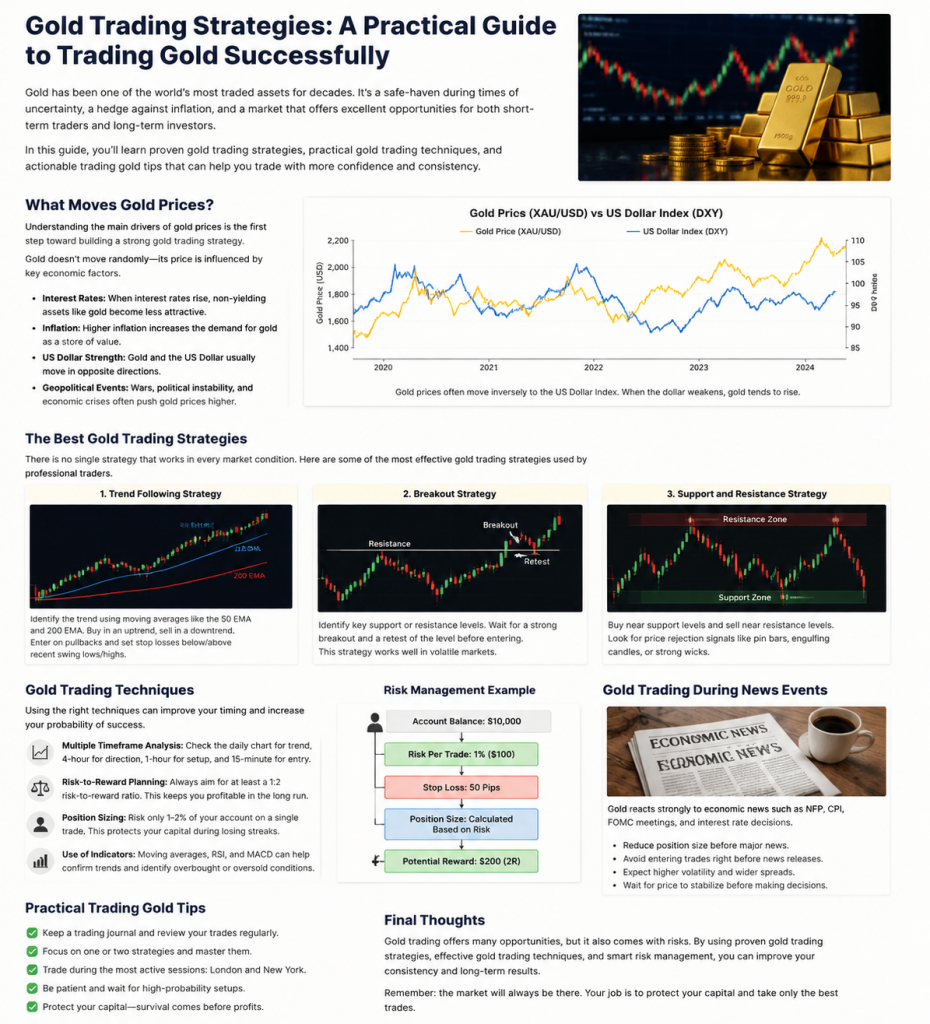
Insert a chart showing Gold (XAU/USD) versus the US Dollar Index (DXY) to illustrate their inverse relationship.
The Best Gold Trading Strategies
There is no single gold trading strategy that works in every market condition.
Professional traders typically use different approaches depending on volatility, trend strength, and market structure.
Strategy 1: Trend Following
Trend trading remains one of the most reliable gold trading strategies.
How It Works
The goal is simple:
- Buy during uptrends
- Sell during downtrends
- Avoid trading against the dominant trend
Setup
Use:
Bullish condition:
- Price above both EMAs
- 50 EMA above 200 EMA
Bearish condition:
- Price below both EMAs
- 50 EMA below 200 EMA
Entry
Wait for a pullback toward the 50 EMA.
Look for bullish or bearish confirmation candles before entering.
Stop Loss
Place below the recent swing low for long positions.
Place above the recent swing high for short positions.
Take Profit
Target at least a 1:2 risk-reward ratio.
EMA trend-following chart showing a pullback entry and continuation move.
Strategy 2: Breakout Trading
Gold frequently consolidates before making explosive moves.
This makes breakout trading one of the most popular gold trading techniques.
Step 1
Identify a clear resistance or support zone.
Step 2
Wait for a candle to close beyond the level.
Step 3
Watch for increased volume or strong momentum.
Step 4
Enter on a retest of the breakout level.
Many beginners enter too early and get trapped by false breakouts.
Waiting for a retest often improves trade quality.
Strategy 3: Support and Resistance Trading
Support and resistance remain essential concepts for gold traders.
Support:
A price area where buyers previously entered the market.
Resistance:
A price area where sellers previously entered the market.
Trading Method
Buy near support.
Sell near resistance.
Look for confirmation from:
- Pin bars
- Engulfing candles
- Rejection wicks
- Strong momentum candles
This is one of the simplest tips on trading gold for beginners.
Gold Trading Techniques Used by Experienced Traders
Successful traders focus on process rather than prediction.
The following gold trading techniques are commonly used by professionals.
Multiple Timeframe Analysis
A common mistake is trading from only one chart.
Instead:
Daily Chart:
Determine overall trend.
4-Hour Chart:
Identify key levels.
1-Hour Chart:
Locate trade setups.
15-Minute Chart:
Fine-tune entries.
This approach helps traders avoid entering against higher-timeframe momentum.
Risk-to-Reward Planning
Many traders focus only on winning.
Professional traders focus on expected return.
For example:
Risk:$100
Potential Reward:$300
Risk-to-Reward:1:3
Even with a 40% win rate, a trader can remain profitable.
This is one of the most important trading gold tips that beginners often ignore.
Position Sizing
Never risk too much on a single trade.
A common guideline is:
- Risk 1% per trade
- Maximum 2% per trade
Example:
Account Size:$10,000
Risk:1%
Maximum Loss:$100
This approach helps preserve capital during losing streaks.
Trading Gold During Major News Events
Gold reacts strongly to economic releases.
Important events include:
- Non-Farm Payrolls (NFP)
- CPI Inflation Reports
- Federal Reserve Meetings
- FOMC Statements
- Interest Rate Decisions
- GDP Releases
Tips for Gold Trading During News
- Reduce position size.
- Expect wider spreads.
- Avoid entering seconds before announcements.
- Wait for volatility to settle.
- Trade only if a clear setup appears.
Many accounts are damaged because traders underestimate news volatility.
Common Mistakes Gold Traders Make
Learning what not to do is just as important as learning strategies.
Overtrading
Not every day provides quality opportunities.
Sometimes the best trade is no trade.
Moving Stop Losses
Many traders widen stops after entering.
This often turns small losses into large losses.
Ignoring Risk Management
Even excellent setups fail.
Risk management protects your account when the market behaves unexpectedly.
Chasing Price
If gold has already moved significantly, wait for a pullback.
Chasing often leads to poor entries.
Trading Without a Plan
Every trade should have:
- Entry
- Stop Loss
- Take Profit
- Position Size
Before the trade is placed.
Practical Trading Gold Tips
Here are some practical trading gold tips that can improve performance immediately.
Keep a Trading Journal
Record:
- Entry reason
- Exit reason
- Market conditions
- Emotions
- Lessons learned
Reviewing trades regularly helps identify recurring mistakes.
Focus on One Strategy
Many traders jump from system to system.
Master one gold trading strategy before testing another.
Follow Market Sessions
Gold tends to be most active during:
- London Session
- New York Session
Volatility often increases when these sessions overlap.
Be Patient
Patience is a competitive advantage.
Professional traders spend more time waiting than trading.
Protect Capital
Your first goal is survival.
A trader who preserves capital can always find another opportunity.
Sample Gold Trading Plan
A simple trading plan might look like this:
Market:XAU/USD
Trend Filter:50 EMA and 200 EMA
Risk:1% per trade
Entry:Pullback in trend direction
Stop Loss:Below recent swing
Target:Minimum 1:2 risk-reward
Maximum Trades:3 per day
News Filter:
No trading 15 minutes before major events
Following a structured plan helps remove emotional decision-making.
Is Gold Good for Beginners?
Gold can be suitable for beginners if approached correctly.
Advantages:
- Strong liquidity
- Clear technical patterns
- Abundant educational resources
Challenges:
- High volatility
- Fast price movements
- Emotional pressure
New traders should start with smaller position sizes and focus on consistency rather than quick profits.
Final Thoughts
Gold remains one of the most attractive markets for active traders. Its combination of liquidity, volatility, and global relevance creates opportunities in both trending and ranging conditions.
The most successful traders do not rely on prediction. Instead, they follow a structured process, manage risk carefully, and remain disciplined during both winning and losing periods.
By combining proven gold trading strategies, practical gold trading techniques, and disciplined execution, traders can improve their decision-making and develop a more sustainable approach to the gold market.
Remember that no strategy wins every trade. Long-term success comes from consistency, patience, and effective risk management rather than chasing the next big move.
